From Idea to a Running SaaS: Building PaperChai as a Real-World Product
Overview
PaperChai started as a simple question:
Why is managing invoices and payments still painful for freelancers and small businesses?
As a full-stack developer, I’ve seen this problem repeatedly — scattered invoices, unclear payment status, follow-ups done manually, and zero visibility into cash flow. Existing tools were either too complex, too expensive, or not designed for early-stage freelancers.
This case study documents how I took that problem and converted it into a production-ready SaaS platform, built with real-world constraints, tight timelines, and scalable architecture.
The Business Problem
Freelancers don’t just need invoices.
They need clarity.
Key pain points identified:
- No single view of outstanding vs paid invoices
- Manual follow-ups and unreliable reminders
- No insight into client payment behavior
- Tools overloaded with features that don’t matter early on
The challenge was to simplify financial tracking without dumbing it down.
Project Goal
PaperChai was built as an internal product / client-style project, with the same standards I follow for paid client work.
The goal was to deliver:
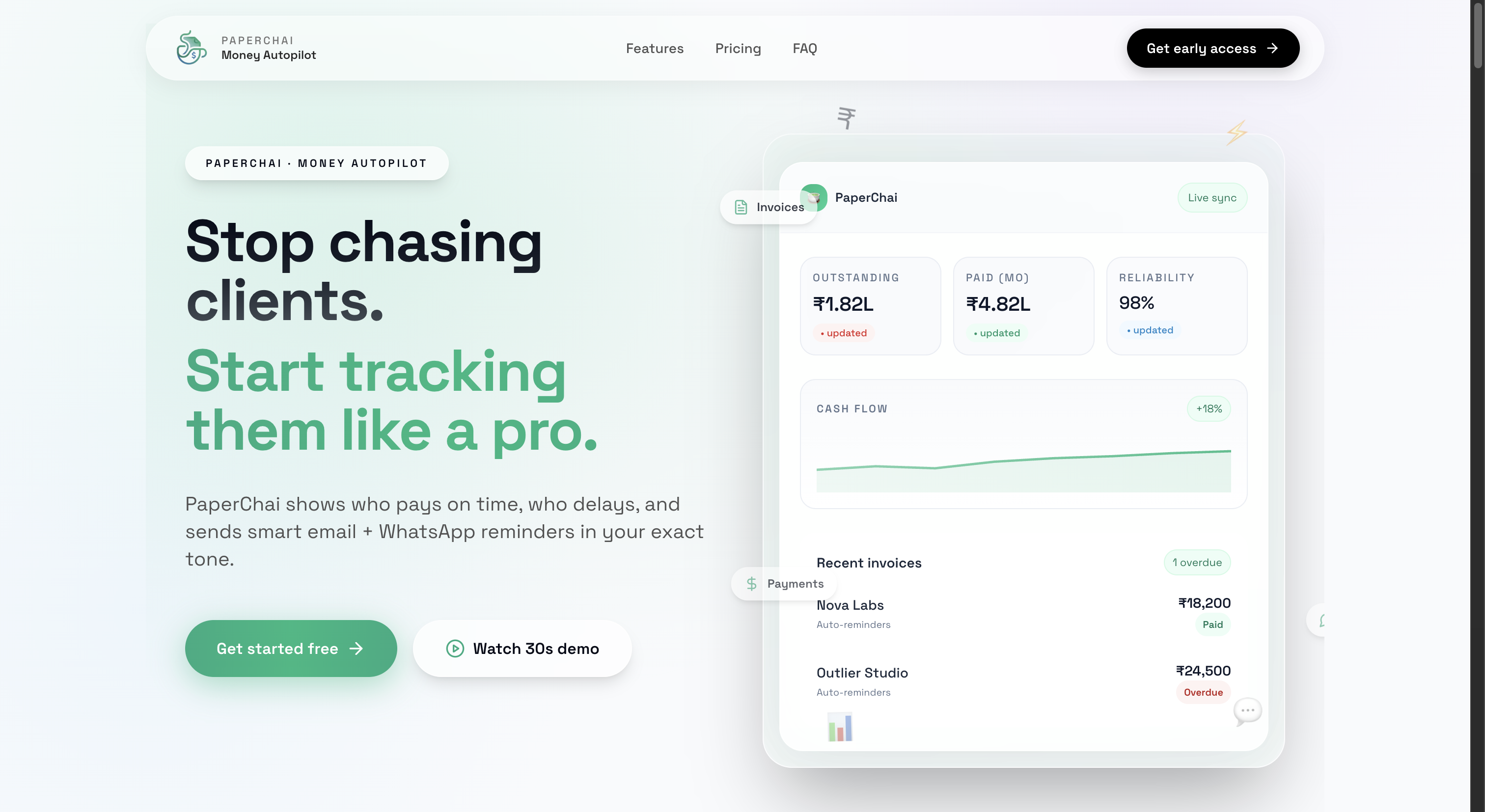
- A clean dashboard with financial visibility
- Simple invoice creation and tracking
- Payment status clarity (paid / pending / overdue)
- A scalable foundation for automation and analytics
- Fast delivery without sacrificing structure
Constraints & Real-World Considerations
This project was executed under realistic constraints:
- Solo developer
- Time-bound delivery
- Cost-efficient stack
- SEO-friendly frontend
- Long-term extensibility
Every technical decision was made with future growth in mind, not just MVP speed.
Technical Architecture & Decisions
Frontend
- Next.js (App Router)
Chosen for performance, SEO, and routing flexibility. - Component-driven UI
Modular, reusable components for long-term maintainability. - Responsive & accessible layout
Optimized for desktop and mobile workflows.
Backend & Data
- Structured APIs designed around business entities:
- Clients
- Invoices
- Payments
- Clear separation between business logic and presentation
- Schema designed to support future analytics and AI features
UI/UX Philosophy
- Minimal, distraction-free interface
- Business-first metrics, not vanity visuals
- Fast interactions with clear feedback
Execution Timeline
A clear execution plan was followed:
- Day 1–2
Requirement analysis, feature prioritization, data modeling - Day 3–6
Core dashboard, navigation, client & invoice flows - Day 7–10
Payment tracking, status logic, UI polish - Day 11
SEO setup, deployment, final QA pass
This approach ensured fast delivery without shortcuts.
What Was Delivered
PaperChai shipped as a fully functional SaaS foundation, including:
- Dashboard with key financial metrics
- Client management system
- Invoice creation and tracking
- Payment status handling
- Clean, responsive UI
- SEO-ready structure
- Production-ready routing and layout
Everything was built to be extended, not rewritten.
Results
Instead of a demo app, PaperChai became:
- A real, working product
- A foundation ready for user onboarding
- A scalable base for automation and AI features
- A practical example of turning an idea into a live system
The project validated that clarity beats complexity, especially for small businesses.
Key Learnings
- Shipping fast doesn’t mean cutting corners — it means prioritizing correctly
- Business metrics matter more than UI effects
- Designing for future features early saves massive refactor time
- Clear structure beats over-engineering
Closing Thoughts
PaperChai reflects how I approach product development:
- Start with real problems
- Build with business context
- Deliver fast, but correctly
- Design for growth from day one
If you’re looking to convert an idea into a production-ready product, this is the exact workflow I follow.
About the Author
I’m a full-stack developer with experience building scalable web products, focused on clean architecture, performance, and business outcomes.
Interested in building something similar?
Let’s talk.
Working on a SaaS that’s starting to feel slow or brittle?
I help founders refactor early decisions into scalable, production-ready systems — without full rewrites.